


The nose is an organ on which human body comfort directly depends.Once his work is disrupted, he can no longer breathe normally and therefore cannot do normal things.The cause of such problems is usually a deformed diaphragm.The most effective way to correct this defect is surgery, but not everyone decides to do this because of fear of the consequences.The good news is that there are other methods you can use to normalize respiratory function.
How does the human nose work?
The nose is divided into three parts: the external nose, the nasal cavity, and the paranasal sinuses.The outside is composed of bone and cartilage.The cavity is located between the eye socket and the mouth.It is divided into two halves by a partition.The septum itself (also called the medial wall) is formed of cartilage and bone tissue.The paranasal sinuses are four pairs of cavities surrounding the nasal cavity that are connected to them by small openings.
Causes of nasal septum deformation and displacement
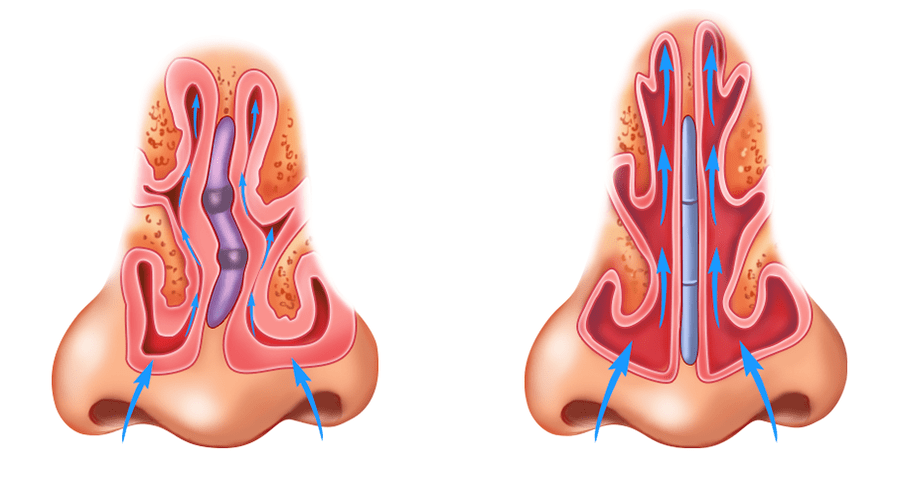
The causes of changes in the shape of the nasal septum are classified into physiological, traumatic and compensatory.Physiological curvature is associated with uneven growth of cartilage and bone.Traumatic displacement is caused by bruises sustained during fights, sports, etc.Compensatory deformations are associated with enlargement of the turbinates, introduction of foreign bodies into the nasal cavity, and the appearance of polyps.As a result, pressure builds up on the plate and it moves.
Types of deviated nasal septum
There are several types of spacer deformation.According to its shape, it is divided into C shape, S shape, comb shape or a combination of these types.Depending on the positioning, it can be located in the front, back, or lower part of the nose.
signs of bending
There are many signs that the diaphragm is deformed.Its severity depends on the type and extent of the displacement.In severe cases, the pathology is visible to the naked eye, and in some people, symptoms may be completely absent due to structural characteristics of the body.An otolaryngologist must diagnose and treat the defect.
The following phenomena indicate that the diaphragm is irregularly shaped:
- snoring;
- difficulty breathing;
- runny nose;
- dryness of mucous membranes;
- Nosebleeds.
Impaired air circulation creates ideal conditions for the development of inflammatory processes in the paranasal sinuses and middle ear within the nasal cavity.Some people's allergic symptoms may worsen and even lead to bronchial asthma.In severe cases, hypoxia can affect internal organs, mainly the lungs and heart.
How to correct the shape of your nose without surgery
Before prescribing treatment, the doctor determines the degree of deformation through examination and a series of procedures (radiography, tomography, rhinoscopy).If the curvature is large, the only option is surgical correction, as this is the only way to restore the correct anatomy of the nose.Indications for surgery include respiratory dysfunction, persistent colds or allergies, and inflammation of the sinuses, middle ear, or Eustachian tube.
For most people, a curved septum does not cause any serious inconvenience.They don't have to go through surgery to straighten it, but use gentler methods: laser correction, medications, clips, massage, breathing techniques.
Laser correction and straightening
The main alternative to traditional surgery is laser correction.This is a minimally invasive procedure that does not compromise the integrity of the mucosa.The cartilage is heated by the laser and becomes pliable enough to be molded into the correct shape.
Despite its advantages, this process also has significant disadvantages.This is a relatively new technology, so there have been no studies on how it might affect patients in the distant future.Recommended if deformation has affected cartilage parts; it is not possible to align the bones in this way.The process is also expensive.
Medical straightening of nasal septum
Deformation does not always affect air circulation.The degree of dyspnea, not the curvature of the cartilage and bone, is taken into consideration when planning treatment.The function of the nose can be normalized not only with surgery but also with medication.Patients are prescribed decongestant tablets or drops, antihistamines (if allergies are present), and steroid sprays to relieve inflammation.
The drug only affects the mucous membrane, so congestion can be eliminated in this way, but septal correction is not possible without surgery or laser correction.This method also has disadvantages.With frequent infusions of vasoconstrictor drugs, vasospasm often occurs.The body initiates compensatory mechanisms and the tissues begin to grow and thicken.As a result, breathing becomes more difficult and the person is forced to use drugs more frequently, which only accelerates mucosal hypertrophy.Only correction can help you get out of the vicious cycle.
Correct deficiencies using folk remedies at home
Normalize nose function without surgery or expensive medications.Reduce swelling of the mucous membranes with an infusion of beet or honey, breathing will become easier after special exercises and massage.
Application of breathing techniques
Gymnastics need to be performed in a fresh air or well-ventilated room.For nasal congestion, it is recommended to use drops first.Before practicing, take a deep breath and hold it for two to three minutes.
- "Palm" exercises can be performed standing or seated.Raise your hands to your chest, elbows bent, palms facing forward.Breathe in sharply through your nose and mouth while clenching your fists.As you exhale, release your fists.
- The figure eight exercise is performed standing with your feet shoulder-width apart.On an inhale, bend forward as far as the stretch allows, holding still and holding your breath.After 5 seconds, exhale and return to the starting position.
- The starting position for the "vacuum" exercise is standing, leaning slightly forward, with your palms on your hips.Inhale deeply through your nose while exhaling sharply, contracting your abdominals as much as possible and hold this position for 10 seconds.
massage therapy curvature
When gentle circular motions are performed, blood begins to flow toward the nose, causing local temperatures to increase, thereby relieving swelling and eliminating congestion.For better results, it is recommended to apply propolis cream to the skin before massaging.
Treatment characteristics of displaced nasal septum in children
Septal deformity often occurs in children under the age of four because the facial bones are so fragile at this time that even minor injuries can cause the cartilage to shift.A baby's nose is often affected during delivery.In addition to mechanical causes, pathology may also be congenital.This occurs if the septum continues to grow when the skull stops growing.
The symptoms of a deviated nasal septum in children are the same as in adults: nosebleeds, runny nose, snoring, and in severe cases, the need for mouth breathing.
If any of these signs appear, it is necessary to take the child to an otolaryngologist, who will make a diagnosis and prescribe treatment.Usually they treat it with medication to normalize breathing.Displacement of cartilage and bone in children under sixteen is rarely surgically removed because the skull has not yet formed.Surgery is used only if the curvature is severe.
In order not to aggravate the condition of a child with a bent partition, his room should be well ventilated.In addition, children with similar symptoms should avoid colds to avoid further burdening the respiratory system.
How to prevent deviated nasal septum
There are no preventive measures for congenital atrial septal defects.Only mechanical damage causing deformation can be avoided.To do this, you need to follow safety precautions when playing traumatic sports (martial arts, ball sports) and avoid conflicts with others that could lead to fights.
Let's summarize
For many people, a deviated septum does not bother them.But if it significantly complicates breathing, treatment should be started immediately.Prolonged exposure can lead to chronic runny nose, lack of oxygen and damage to internal organs.Non-surgical treatments, although considered less effective, can normalize nose function and return a person to a comfortable life.